

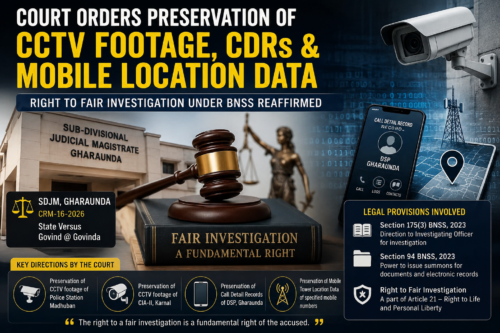
SDJM Gharaunda Reaffirms the Right to Fair Investigation under BNSS, 2023
The Sub-Divisional Judicial Magistrate (SDJM), Gharaunda, Haryana, has passed a significant order emphasizing that an accused’s right to a fair investigation extends beyond the mere registration of an FIR. The Court directed the Investigating Officer to preserve CCTV footage from multiple police establishments, preserve the Call Detail Records (CDRs) of a senior police officer, and secure mobile tower location data after allegations that a police encounter had been staged.
The order is particularly relevant for criminal practitioners and law students because it discusses the scope of Section 175(3) BNSS (formerly Section 156(3) CrPC), Section 94 BNSS (formerly Section 91 CrPC), the constitutional requirement of a fair investigation, and the evidentiary importance of electronic records.
Background of the Case
The accused claimed that he had voluntarily surrendered before the DSP at Police Station Madhuban in connection with another FIR. According to him, after his surrender he was taken into police custody, but later the police projected a different version stating that he had been apprehended after opening fire on the police party, during which he sustained a gunshot injury to his leg.
Since both versions could be objectively verified through electronic evidence, the accused sought directions for preservation of:
- CCTV footage of Police Station Madhuban;
- CCTV footage of CIA-II, Karnal;
- Call Detail Records of the DSP, Gharaunda; and
- Mobile tower location data of specified mobile numbers.
Court Criticises Police for Absence
Before considering the application, the Court noted that neither the Investigating Officer nor any police representative appeared despite the serious nature of allegations involving a purported fake encounter.
The Court observed that if the SHO was unable to appear due to illness, another responsible officer should have been deputed. It directed that the matter be brought to the notice of the Superintendent of Police, Karnal, for appropriate action against the erring officials.
Right to Fair Investigation is a Fundamental Right
The Court reiterated that an accused is constitutionally entitled to a fair and impartial investigation.
Where competing versions exist regarding the manner in which an accused was apprehended, the Investigating Officer has a duty to objectively examine both narratives instead of merely accepting the police version.
The Court relied upon:
- People’s Union for Civil Liberties v. State of Maharashtra (2014) 10 SCC 635
- Raju @ Raj Kumar v. State of U.P. (Allahabad High Court, 2026)
to underline that allegations relating to encounter cases require careful and objective investigation.
CCTV Footage Must Be Preserved
One of the most important observations in the order concerns CCTV footage installed in police stations.
Referring to the Supreme Court judgment in Paramvir Singh Saini v. Baljit Singh, the Court observed that every police station is required to install CCTV cameras and preserve the recordings so that allegations of custodial violence, fake encounters, or other human rights violations can be independently examined.
The Court therefore directed preservation of CCTV footage from:
- Police Station Madhuban; and
- CIA-II, Karnal,
holding that the investigation is not restricted to the territorial jurisdiction of the police station where the FIR is registered and relevant evidence may exist elsewhere.
Can the Court Order Preservation of a Police Officer’s Call Detail Records?
An interesting issue before the Court was whether the Call Detail Records of the DSP could be preserved despite privacy concerns.
The Court observed that the accused sought the CDRs only for a specific day when the officer was allegedly performing official duties. Since the request had a direct connection with verifying whether the accused had actually surrendered before the police, the Court held that the right to privacy is not absolute and must yield where disclosure is necessary to ensure a fair investigation.
Police Cannot Avoid Collecting Digital Evidence
The prosecution argued that mobile location records were with telecom companies and not with the police.
Rejecting this contention, the Court held that under Section 94 BNSS, 2023, the Investigating Officer possesses statutory authority to require production of documents and digital evidence from service providers during investigation. Therefore, inability to obtain such records could not be accepted as a valid defence.
Final Directions of the Court
The SDJM allowed the application and directed the Investigating Officer to preserve:
- CCTV footage from Police Station Madhuban;
- CCTV footage from CIA-II, Karnal;
- Call Detail Records of the DSP, Gharaunda; and
- Mobile tower location data relating to the specified mobile numbers.
The Court clarified that preservation of CCTV footage should not be narrowly confined to the exact time sought by the accused but should include the entire relevant footage.
Legal Significance
The order is significant because it reinforces several important principles under the BNSS:
- A fair investigation is a fundamental right of the accused.
- Courts can issue directions for preservation of electronic evidence during investigation.
- Investigations are not geographically confined to the police station where the FIR is registered.
- Section 94 BNSS empowers Investigating Officers to obtain electronic records from telecom service providers.
- Privacy claims of public officials may be balanced against the requirements of a fair criminal investigation where the information sought directly relates to official acts.
Key Takeaway
This order demonstrates how electronic evidence has become central to criminal investigations under the BNSS, 2023. CCTV recordings, Call Detail Records, and tower location data are no longer merely corroborative evidence—they can become decisive in testing rival versions of events.
The judgment also illustrates the growing judicial emphasis on transparency in police investigations and the Court’s willingness to intervene at the investigation stage to prevent the loss of crucial digital evidence.